Sometimes a product starts because the market is missing something.
Sometimes it starts because you are simply tired of using tools that do not feel built for the way you think.
Skedoff began from the second kind.
It was not born out of a grand startup idea.
It started from a very practical frustration:
I wanted a simple way to prepare social posts offline, keep them private, and publish them when I was ready — without being forced into someone else’s cloud, subscription, account system, or automation model.
That simple frustration became a real app.
And now, after many iterations, the UI is done, the database is done, and the core already works.
It is not released yet.
Because now I am in the phase that matters most:
polishing the experience until it feels honest enough to ship.
Why I Started Building It
Most social media scheduling tools are built around the same assumptions:
- you will create an account
- you will connect your social platforms
- you will trust a third party with your drafts
- you will likely pay monthly
- you will automate publishing as much as possible
That model works for teams, agencies, and marketing pipelines.
But it never fully worked for me.
I do not always want automation.
Sometimes I just want a quiet place for unfinished words.
A place where I can:
- draft something offline
- decide which platform it belongs to
- set a reminder for later
- return when the moment feels right
- copy, paste, and publish intentionally
That is a very different feeling from “schedule and forget.”
And once I realized that, the idea became clear:
Skedoff should not try to be another cloud scheduler.
It should be something smaller, calmer, and more personal.
What Skedoff Actually Is
At the simplest level, Skedoff is an offline-first social media content planner.
But that description is only partially true.
Because the more I built it, the less it felt like a scheduler.
It started to feel more like this:
a private staging space between writing and publishing
That is the real idea behind it.
Not “auto-post everywhere.”
Not “optimize your content pipeline.”
Not “scale your social output.”
Just:
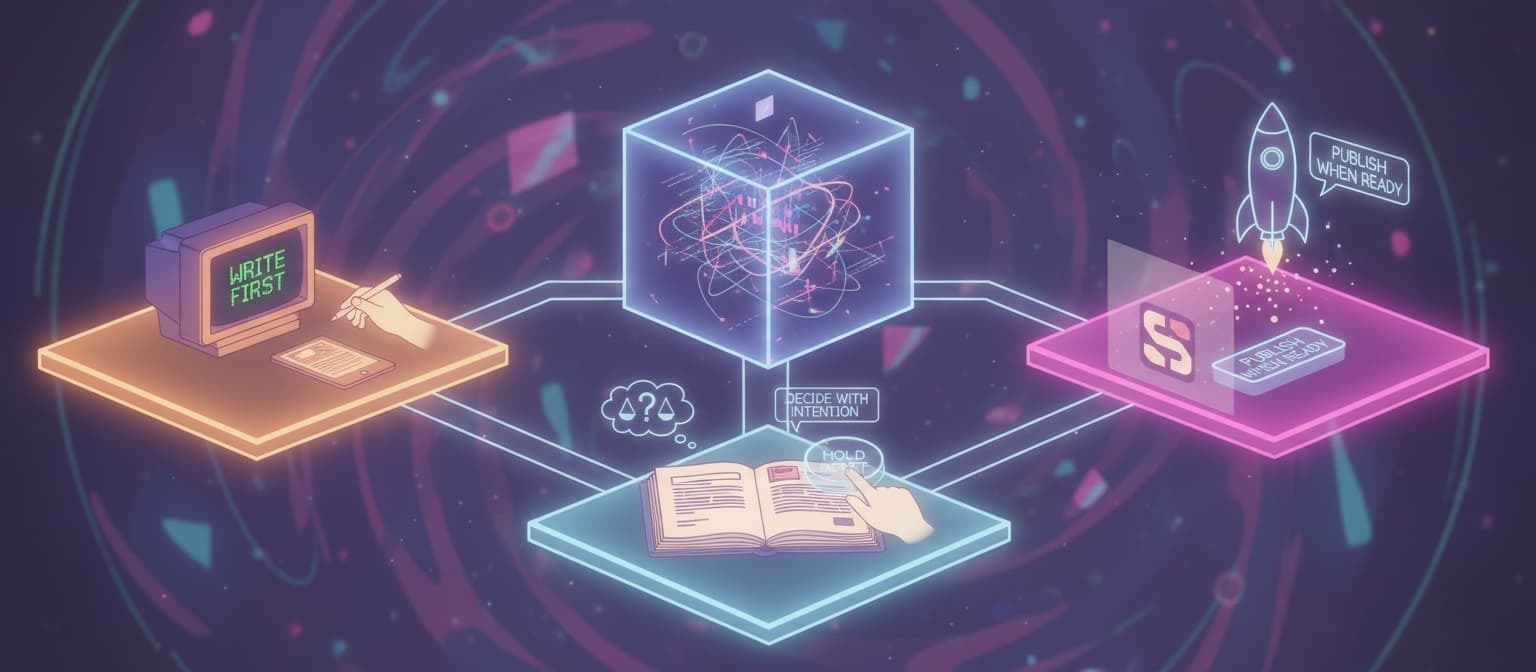
- write first
- hold the draft
- decide with intention
- publish when ready
That is why the tagline became:
Plan content offline. Post when ready.
That line is not just marketing.
It is the product philosophy.
Why the Name Is Skedoff
The name came later than I expected.
And it mattered more than I thought it would.
Skedoff comes from two ideas:
- schedule
- offline
But the “off” part matters for more than just technical reasons.
It also reflects the emotional shape of the product:
- off the cloud
- off the pressure
- off the noise
- off the endless urgency to publish immediately
That felt right.
Because this app is not built around speed.
It is built around control.
The Core Concept
The core workflow is intentionally simple:
- Write offline
- Tag the platform
- Set a reminder
- When ready: copy, paste, publish
That is it.
No login.
No platform connection.
No API dependency.
No subscription wall.
No invisible server in the background holding your drafts.
Your content stays on your device until you decide it is ready.
That decision was not a limitation.
It was the whole point.
Why I Chose Offline-First
Offline-first is often treated like a technical feature.
For Skedoff, it is also a philosophical one.
I wanted a tool where:
- the app still works without internet
- writing is not blocked by connectivity
- drafts are not tied to external services
- privacy is the default, not a premium feature
- ownership is built into the architecture
That is why Skedoff stores everything locally.
No cloud sync.
No remote dashboard.
No required account.
No automatic upload of your content to some backend just because you opened the app.
For a lot of products, that would be considered a missing feature.
For this one, it is the foundation.
What I’m Building Into It
Even though the philosophy is quiet, the app itself is not barebones.
Skedoff is being built as a practical tool I would actually want to use every day.
Core direction
- Offline-first by default
- No account required
- No cloud dependency
- Local-only data storage
- Multi-platform support
- Reminder-based publishing flow
- Human-in-the-loop, not automation-first
Planned practical features
- platform tagging (X, Threads, LinkedIn, Instagram, TikTok, Facebook, YouTube, and more)
- draft queue organized by date, platform, or status
- status flow: Draft → Queued → Posted
- local notifications when a post is due
- character counters per platform
- copy-to-clipboard flow for instant publishing
- search and filtering
- reusable templates
- export options for drafts
- dark, quiet interface with minimal friction
The goal is not feature bloat.
The goal is enough structure to support writing without turning the tool into noise.
The Build Process So Far
Right now, the project is in a good place structurally.
Current status
- UI is done
- database is done
- core flow already works
That means the app is no longer just an idea or mockup.
The foundation exists.
The main build is already real.
I am building it with Flutter, because I want the same product philosophy to work across multiple platforms without fragmenting the experience:
- Android
- iOS
- Windows
- macOS
- Linux
For local storage, I am keeping things device-first with a local database architecture rather than cloud-backed assumptions.
That decision affects everything — not just storage, but the entire UX.
When an app is truly local-first, every interaction feels different:
- faster
- quieter
- less dependent
- less intrusive
That is exactly what I want.
Why It Is Not Released Yet
This is the important part:
Skedoff is not released yet.
Not because the concept is unclear.
Not because the app is broken.
Not because the core is missing.
The reason is simpler:
I want it to feel more polished before release.
Right now, the remaining work is mostly in the layer that people often underestimate:
- refining the UX
- tightening the interaction flow
- improving the small transitions
- making the writing experience feel calmer
- reducing friction in edge cases
- making the app feel deliberate, not just functional
A lot of apps are technically “done” before they are emotionally ready.
I do not want to ship Skedoff too early just because the checklist says I can.
This product depends on trust.
And trust is often built from the details.
What I Want the Experience to Feel Like
This matters to me more than raw features.
I do not want Skedoff to feel like:
- a marketing dashboard
- a noisy SaaS panel
- a growth-hacking tool
- a social media control center
- a “productivity” app that creates more stress than it removes
I want it to feel like:
- a quiet writing companion
- a holding space for unfinished posts
- a reliable local tool
- a place where drafts can exist without pressure
- a deliberate pause between creation and publication
That is the emotional design target.
Not just “usable.”
Not just “clean.”
But calm.
What I Learned While Building It
The biggest surprise is this:
I thought I was building a scheduler.
I am not.
I am building a boundary.
A boundary between:
- writing and posting
- intention and impulse
- ownership and dependency
- private thought and public publishing
That is what changed the project for me.
And honestly, that is what made me want to keep building it.
Because the internet has enough tools trying to accelerate us.
I wanted to make one that gives a little space back.
What Comes Next
Before release, I still want to improve:
- UX polish
- flow clarity
- platform-specific writing constraints
- edge-case handling
- reminder behavior
- overall visual quietness
- release readiness across platforms
The foundation is there.
Now it is about making the product feel like itself.
Not just functional.
Not just finished.
Ready.
Final Thought
Skedoff is a small app.
But I do not think small ideas are small when they solve the right tension.
For me, that tension is simple:
How do you keep ownership of your words before the internet gets them?
Skedoff is my answer to that question.
It is still in progress.
Not released yet.
But it is real now.
And I am taking the time to make sure it becomes the kind of tool I would trust with my own drafts.
Still building.
